10 major projects including:
Experiment #1 : On Drawing : An article on drawing promotes drawing on an article
Read the article on Richard Long's drawings and what they can be
Read Sol LeWitt's Sentences on Conceptual Art
Definition of drawing =
“The making of marks with meaning” . Robert Kaupelis, renowned drawing professor at NYU
OR:
a mark-making process used to produce a line - based composition on a ground.
Examples:
1. In figure drawing Jennifer made charcoal drawings on paper. The mark- making medium was vine charcoal; her ground, also known as the substrate, was white drawing paper.
OR:
a mark-making process used to produce a line - based composition on a ground.
Examples:
1. In figure drawing Jennifer made charcoal drawings on paper. The mark- making medium was vine charcoal; her ground, also known as the substrate, was white drawing paper.

2. In Richard Long’s drawing above, made as he walked for 11 days between the west and east coasts of England, his mark-making medium was his body and the ground on which he drew (left a record of his movement and observed/selected found marks) was the earth.
EXPERIMENT RULES
Part 1: Read the article from The Guardian on Richard Long
 |
| Richard Long Walking a Line in Peru 1972 |
Part 2: Write a one page essay about what drawing is for you and what it can be.
 |
| Richard Long Five Stones |
Part 3: In this next step of the project you are to use the article as the ground for a drawing that is inspired by the article.


- Scan, photocopy, photograph the article > create some sort of physical artifact of the article.
- You must use the whole physical article by what ever reproductive means you choose.
- The article does not have to remain in tact.
- You can use any media you choose.
- You can use mechanical and reproductive means.
- Completed work may be any size.
- You should come prepared to “install” your drawing so that it is well presented prior to critique.
 | |
Richard Long drawing
|


Experiment #2 : Drawn Systems
Drawing as process, making use of the unit to the sum of the parts - informed by the found text of Huckleberry Finn, 1884 by Mark Twain as substrate
Question: Did you develop an abstract system that effectively/successfully materialized (make physical and visual) the concept of Twain's work?

exercise #1: Entopic Graphomania
 Place dots on specific words or letters. You choose what set of marks, words, or letters you want.
f o u n d p o e t r y


random chance random chance random chance random chance random chance random chance rando
random chance random chance random chance random chance random chance random chance rando
random chance random chance random chance random chance random chance random chance rando
random chance random chance random chance random chance random chance random chance rando
random chance random chance random chance random chance random chance random chance rando
This exercise is based on a Surrealist game.
Simply grab a sheet of paper—it can be a page from an old paperback book, or anything with markings.
 Place dots on specific words or letters. You choose what set of marks, words, or letters you want.
Connect the dots with straight, curved, or zigzag lines to create a pattern. An exercise like this will reveal hidden patterns and shapes in a system-ruled drawing. Engage in randomness -- there is ALWAYS potential found there!
In Action: Entopic Graphomania video


Allow your choice of media, your mark making become meaningful to the context of the text - keep your marks non-objective. Be wary of falling back into old habits of what feels comfortable, or what you feel the drawing should look like.
Such assumptions are based in old ways of thinking and what you believe a good drawing SHOULD look like.
E X P E R I M E N T A T I O N is key! Do not worry about what the drawing ends up being. Be I N V O L V E D in allowing the concept of the page / the found book / etc. lead you into new ways of connecting concept / narrative with your choice of media a mark.
Experiment #3 : Drawing from Another; the human figure
Drawings that make use of observational sighting from the nude human model
We map the world by the connection with others.
Experimentation of positive form impacting the negative void.
We will work in both wet and dry media - varying scales.
Experiment #4 : Media Spills & Fallen Paintings : drawing as installation
Use drawing to create/transform/reinterpret existing space

Barry La Va b. 1941 Process Art
Process Art is a movement that situates the "process" of making art as dominant idea. It is a style that is not interested in predetermined ideas or compositions. Other Process artists include: Eva Hesse, Lynda Benglis, Robert Morris, Robert Smithson, Richard Serra, Bruce Nauman, Alan Saret and Keith Sonnier.

Robert Morris felt work

Richard Serra 'drawing'
See also :: Guggenheim Museum Process Art exhibition
YouTube video with Tuttle 'drawing'
current:
Polly Apfelbaum


Donald Judd

a hope chest

the seven dwarves
Process Art:
Part A
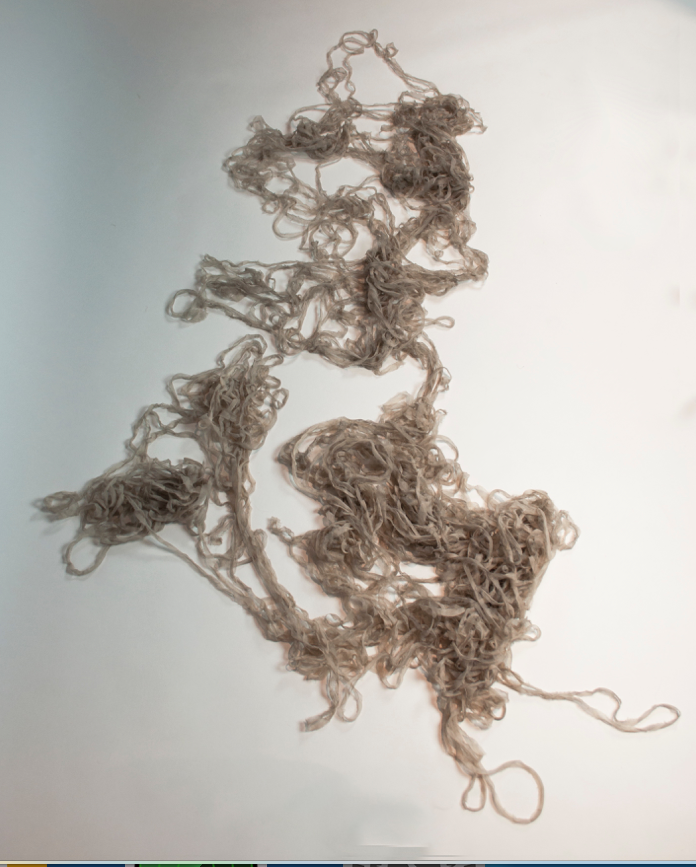
> Make a drawing with string or some sort of malleable length (chain, hair, etc).
> Think about the back ground it is going on. Do not attach it to a substrate.
> Photograph it.
> Dismantle.
> Do two more drawings, making now 3 separate 'drawings.'
> Print these out, or refer to them digitally.
PART B:
> What inspires you?
> Keep a running list throughout this experiment (think back to Apfelbaum and her inspiration of Power Puff Girls, hope chests and the works of Minimalist Donald Judd)
> You need to experiment with materials (wet and dry)in new ways and actions
> Use materials on new substrates
> Commit to a media that you wish to delve in further with
> Accumulate Formalist marks and shapes from this material and action
> Install in an area (any scale)
> Photograph
> Disassemble
> Reorganize again
> Repeat for a total of 3 different installations
> Print in color 8 x 11" minimum
> Bring in photographs and the actual parts that made up your installation
Experiment #5 : Round Robin & Beyond the Exquisite corpse : Collaborative Works
Collaborative drawings engaging the entire class moving around the room and working on 3 canvas drawings becomes a collection of varying interpretations and responses.
Among Surrealist techniques exploiting the mystique of accident was a kind of collective collage
of words or images called the cadavre exquis (exquisite corpse).
Based on an old parlor game, it
was played by several people, each of whom would write a phrase on a sheet of paper, fold the
paper to conceal part of it, and pass it on to the next player for his contribution.
The technique got its name from results obtained in initial playing, "Le cadavre / exquis / boira /
le vin / nouveau" (The exquisite corpse will drink the young wine). Other examples are: "The
dormitory of friable little girls puts the odious box right" and "The Senegal oyster will eat the
tricolor bread."
These poetic fragments were felt to reveal what Nicolas Calas characterized as the
"unconscious reality in the personality of the group" resulting from a process of what Max Ernst
called "mental contagion."
At the same time, they represented the transposition of Lautréamont's
classic verbal collage to a collective level, in effect fulfilling his injunction-- frequently cited in
Surrealist texts--that "poetry must be made by all and not by one."
The game was adapted to the possibilities of drawing, and even collage, by assigning a section of
a body to each player, though the Surrealist principle of metaphoric displacement led to imagesthat only vaguely resembled the human form.
* For examples of the original Exquisite Corpses, check out the slide show at: http://
www.exquisitecorpse.com/definition/About.html
Source: "Dada & Surrealist Art," by William S. Rubin
Experiment #6 : Body as Measurement
Drawings that make use of one's physicality as a way of perceiving and framing the world
The self is insistent.
Our experiences with the world take on meaning because of the way
our bodies experience the world. Our experiences become the material out of which we
make art.
Experiment #6 :
Measure some aspect of your body.
Use that quantity and method of quantifying your body to inspire a drawing.
The relationship between concept and form and use of materials:
Question: Did
you develop a way to effectively/successfully materialize (make physical and visual) your
particular measure of your body? Is the relationship between the “thing” you made and
your concept (the way you measured your body) effective?
Experiment #7 : Obsessive Drawing & Performance Art
Either using your own body, or creating a device that makes repetitive marks, construct a narrative, ritual, or action. The final drawing will be an artifact, a residue of the performance. The 'object' drawing will define area, time, energy, dimension, scale and object
Experiment #8 : Mapping Time & Space
Drawings that construct a narrative that maps areas over a period of time
Experiment #9 : Micro Macro Relationships & mixed media collages
Unique drawings that amplify their relationships to each other and are found in nature, in math and in the sciences, etc. Mixed media collages that are informed by Dadaist principles of chance and randomness, and the power of 'Fortune'
Experiment #10 : Poetic Marks & Repetitive Actions Final project
Conceive of drawing as leaving traces on the world, either in human-built environments, or natural environments. This concept could result in an object, documentation of the action in photos or video, a performance, or a combination of these